Showing posts with label Animals. Show all posts

Sunday, February 23, 2014

Thieves Among Us


Many folks where I live count birding as a hobby and spend more than a couple of bucks over the course of the winter feeding these lovely winged creatures. But, when you feed the birds you get squirrels. People have been rigging up all sorts of contraptions of wire, filament, metal baffles, whirligigs, and so on just to thwart those seed-stealing busy tails. Now, I like squirrels but I draw the line when they empty a recently filled bird feeder within 30 minutes.


I recently read an article that stated there is no feeder that a squirrel cannot get into. There are, however, squirrel resistant feeders. Reminds me of deer resistant plants – NOT!


Texas is home to the fox, gray, flying and rock squirrels. Ninety percent of the squirrels in east Texas are the gray squirrel (or as they are called in east Texas – limb chickens). Squirrels are very social creatures and have the ability to share knowledge among each other. Imagine if you will, the squirrels discussing who has the best seed and easiest feeder to break into. Baby squirrels learn how to get seed out of a feeder by observing its mother or grandmother.


Squirrels are agile creatures and can rotate their hind feet 180 degrees when descending a tree. With large eyes set on the sides of its head, the squirrel can see all around with little movement of its head. It can see above and below, an adaptation well suited for life in the trees where danger can come from the ground, through the air, or along a nearby limb. Squirrels also have a yellow filter in their eye lenses to help reduce glare and enhance contrast in low-light conditions to improve vision – like night vision glasses so they can find the seed!!

Two to four helpless young are born six or seven weeks after breeding takes place. They are blind and nearly naked and develop slowly.

Photo courtesy of Becky Sheridan
Their eyes open at five weeks, but they do not climb out of the nest for at least seven or eight weeks. They do not get out of their nest tree until they are about ten weeks old. By the time they are three months old, they can fend for themselves. At ten or eleven months they reach sexual maturity, and the cycle can begin again.


Of all of the squirrel-deterrent devices out there, the best is probably the cylinder baffle. It should be 6” in diameter, 18” in length and at least 5’ off the ground. 

Baffle
Umbrella or tilting baffles placed above the feeder are good too. 

Umbrella
Weight activated feeders  are supposed to be good but my squirrels have found they can lay on top of the feeder and still get to the seed. 


Cayenne pepper added to seed works until the squirrels build up a tolerance to it and it has no effect on birds. Word to the wise, don’t add the pepper to your seed outside on a windy day – just sayin.’

I have tried many of the remedies listed above to no avail. I guess I will just sit on the porch in my rocker with a cup of coffee and spend my time seeing how those little boogers get into the feeders. Kind of comical if you ask me.


It could be worse, I guess. 


Sunday, October 20, 2013

Autumn Stroll Around the Ranch


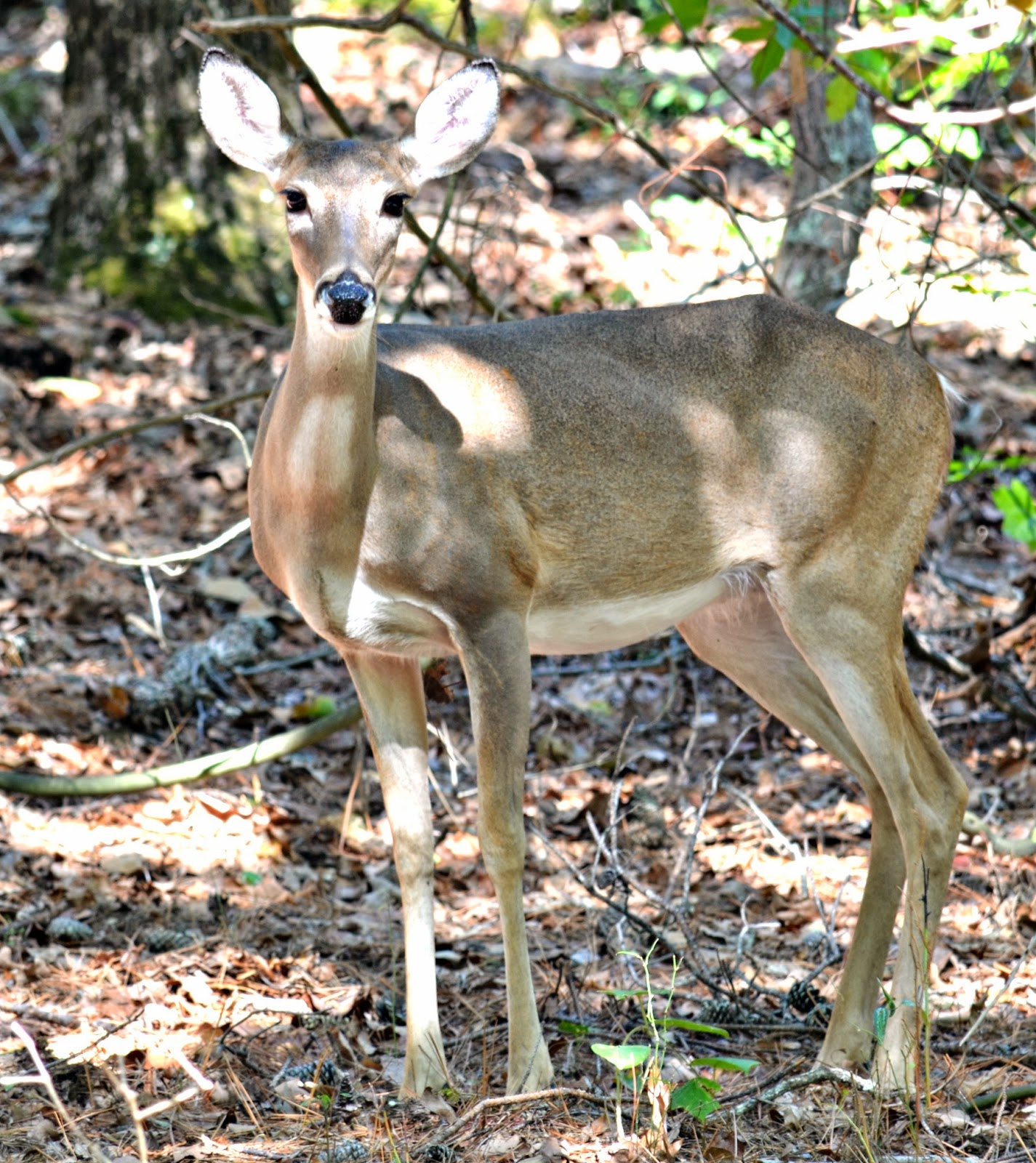
A little solitary time for this doe

Homeowners have begun decorating for the upcoming season


Last of the Poke berries

Even though scorched, this Sweetgum is showing its fall colors
The Sweetgums are one of the first trees to change colors here

A lush carpet of moss

Some creature's hidey hole

This dogwood has no leaves but is full of fruit


Art in nature


Even a log pile can be art

White Gayfeather (Liatris)

The oak leaves are beginning to change

Jack-o-lantern mushroom (Omphalotus olearius) - I think


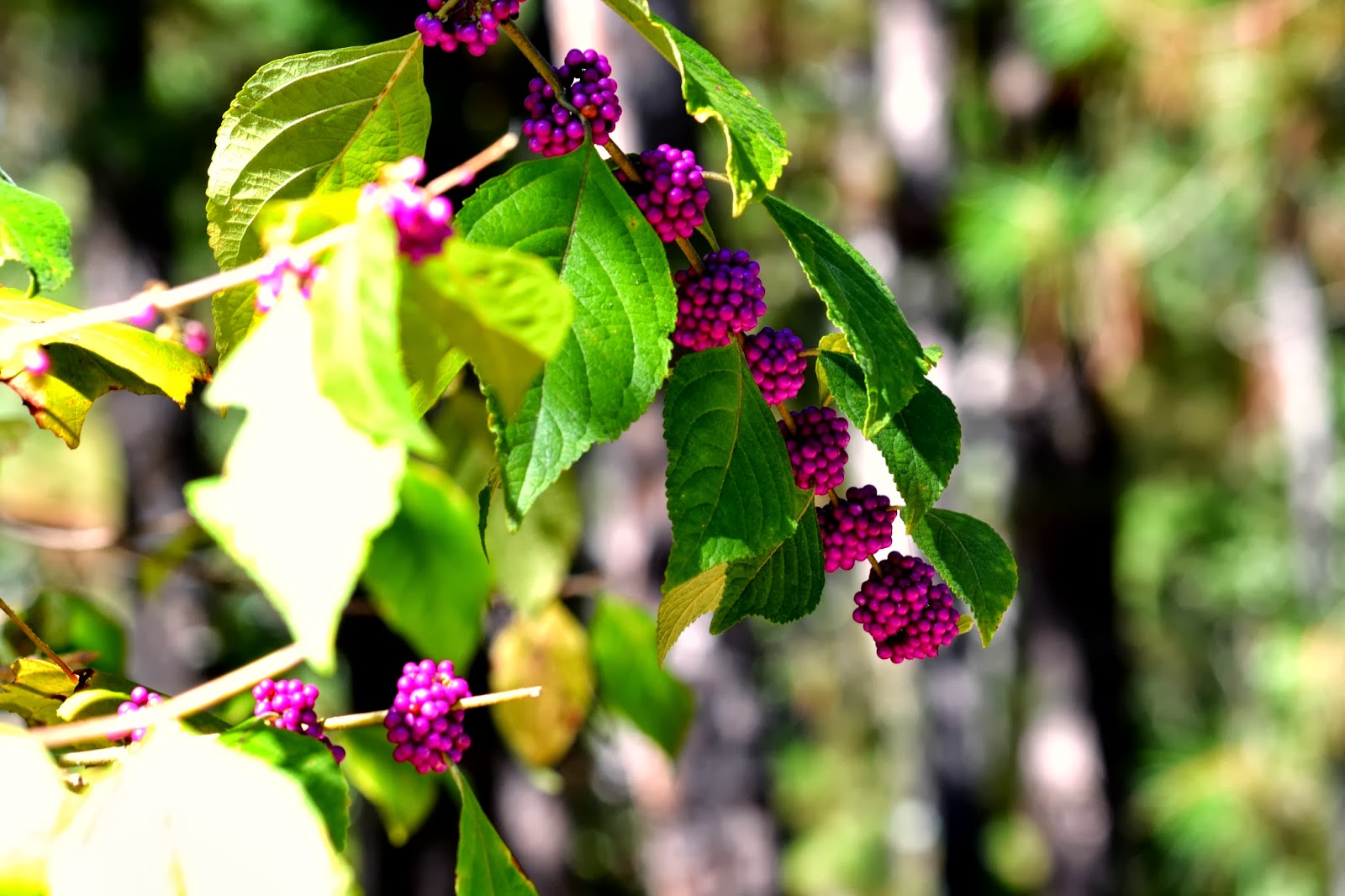
American Beautyberry (Calicarpis americana)

The Yaupons have fruited

Resurrection Fern


Sassafras trees are unusual because they have three distinct 
leaf patterns on the same plant, unlobed oval, bilobed (mitten-shaped), and trilobed (three-pronged)
Colorful trilobed Sassafras leaves


Wednesday, January 23, 2013

It Was a Natural Christmas


Before the holidays, my friend, Lenore, and I were out in the woods gathering greens and berries for our natural Christmas “displays.” We came back to our homes with arms loads of cedar, pine, soap berries, cherry laurel berries, smilax berries and possum-haw berries. And, I came home with the best of the best. An animal skull!! But my happiness was short lived when the family would not let me put it on the top of the Christmas tree.

After the holidays and the decorations stored, I decided to research my “find.”  Identification can be determined by several methods. The best way to identifying a skull to species is with the use of a dichotomous key. This tool allows a person, through a series of questions, to identify an organism to species by process of elimination. The questions are “either/or” (dichotomous) choices. These choices are arranged in “couplets,” or pairs of statements. From each couplet, you choose the statement that best describes the skull. This map will lead you to the name of the mammal or group of mammals or to another couplet. You have to have to patience to work through the steps in sequence until you have a tentative identification.

My photo
Internet photo


In my Master Naturalist classes, we used a dental formula - counting the teeth. Even though some of the teeth are missing in my skull I was able to determine this skull has 40 teeth, and so does a raccoon. The dental formula for a raccoon is 3 incisors, 1 canine, 4 premolars and 2 molars or 40 teeth. It is written as such:


Another way to tell is turn the skull over and look at the hard palate bone (the roof of its mouth). In a raccoon, this bone will go past the molars.

Raccoon palate

Raccoons are opportunistic omnivores with a very broad diet. Their diet consists of roadkill, insects, frogs, birds, snakes, small mammals, slugs, and earthworms. Some of their favorite foods are fruits and MY tomatoes. Omnivore
 teeth 
are
 a
 mix
 of
 herbivore 
and
 carnivore 
teeth. Their sharp-edged incisors and long canines look like those of carnivores, though the canines are not as sharp. The cheek teeth are a blend of herbivore and carnivore teeth - they do not have the tall, sharp points of the carnivore, but do have more groves and blunt points than herbivore teeth.

And, there you have it! Next time you find a skull, try using a dichotomous key and also a dental formula. The cat is getting suspicious and the family doesn't like the ickyness of a dead animal on the kitchen table, so I must dispose of the skull. Naw, maybe I will just hide it.)

Shameless plug here - a new Master Naturalist class is beginning at the Tyler Nature Center on February 23. It is sponsored by Texas AgriLife Extension Service and Texas Parks and Wildlife. Check out their web site:
http://txmn.org/etwd/.

Saturday, October 1, 2011

Oh, Deer!

Spending the Evening with Four Men in the Back of a Pickup Truck

Wood County, Texas’ Holly Lake Ranch has a lot of deer. So many have been seen that community leaders determined a spotlight deer survey needed to be performed to see exactly how many. So, guess whose little hand went up to volunteer to help with this endeavor? Right, mine. I bet you all are jealous that you were not the ones riding around in pick ‘em truck in the middle of the night. The following is a recount, to the best of my recollection, of this fun filled evening and exactly what we did.

Our community obtained a vehicle just for this special occasion. Now this truck isn’t one of the new, cute girly trucks. It is a big, old F110 with a bench seat that is held together with duck tape and baling wire. A board is secured, with vice type clamps, across the sides of the bed truck for seating for the spotters. Spotlights are wired into a battery in the cab. There is a lawn chair for the recorder. There is a driver, two spotters and a recorder. It was deemed that this journey should begin at 9:00 p.m.

Now, I don’t remember drawing straws on who gets to do what. Remember we have one driver, two spotlight people and one recorder. I guess community officials determined that I could neither operate a spotlight nor a pencil and paper. So, guess who got to drive the truck for the deer count . . . moi!!! Hoping everyone’s life insurance is fully paid, I acquiesced.

Now, since the bench seat was unmovable, I had to pull myself up by holding onto the steering wheel just to reach the gas and brake pedals. Thank goodness it was not a manual transmission. I could barely see over the steering wheel let alone the hood of the truck. I had to drive the truck at a speed of 5-7 miles per hour for 4 hours all the while holding myself up by grasping the steering wheel. No causalities occurred but one mailbox came close to being creamed.

Now on to the count. Three counts are taken during a period and then a Texas Parks and Wildlife Biologist will extrapolate the data. He will train a Wildlife Group here in our community in these computations so that we may do this study on a yearly basis. But for all you math whizzes out there, I am going to give you the formulas. Get your slide rules ready.

The first task is taking visibility readings every 1/10th mile. The following formula is used to convert 1/10-mile visibility estimates into acres of visibility:

Total yards of visibilities / number of 1/10mile stops +1 X Number of miles X 1,760 / 4,840 = Visible Acres.  For example, a 7.7-mile line with 4,744 total yards of visibility the formula would be: 4,744 / 77 + 1 X 7.7 X 1,760 / 4,840 = 170.29 acres. Got that?

Then you divide the total number of deer into the total number of visible acres observed to determine the number of acres per deer on the route. For example: 1,260 acres (one spotlight survey route run 3 times with 420 acres of visibility) divided by 90 (total number of deer observed on that spotlight survey route run 3 times) = one deer per 14.00 acres. The estimated deer population for this area can then be estimated by dividing the total acres by the estimated acres per deer figure. For example, the deer population estimate for a 5,000 acres ranch with a deer density of one deer per 14.00 acres is 357 total deer.

Also included in this survey will be buck, doe, and fawn ratios. An estimate of the number of bucks, does, and fawns in the population can then be determined by multiplying the total number of deer by the percent of all deer identified that were bucks, does, and fawns. For example:

357 Deer X 0.20 (% identified as bucks) = 71 bucks,
357 Deer X 0.50 (% identified as does) = 179 does, and
357 Deer X 0.30 (% identified as fawns) = 107 fawns
 TOTAL = 357 deer

In addition, deer identified as bucks, does, and fawns from the spotlight surveys can provide important information on the buck to doe and fawn to doe ratios. Herd composition is crucial to management of deer populations. The ratio of bucks to does provides information on survival of both sexes and is an indicator of hunting pressure on each sex. Fall fawn per doe ratios provide a good index of fawn survival.

Well, if that doesn’t curdle your brain, I don’t know what will. Whatever the final numbers are, it is good that the community is being proactive in keeping our area beautiful with herd of healthy, vibrant deer.