Showing posts with label trees. Show all posts

Sunday, January 18, 2015

Witch's Broom


My friend, Jean B., asked last fall if I was no longer writing my blog and I said, “Oh, yes, I am still writing away.” Not! Truth is I have been so very, very busy lazy. I was beginning to think last year no one was reading my blog, commenting or didn't find it interesting so I just quit! So there! But, just like a bad penny, I am back.

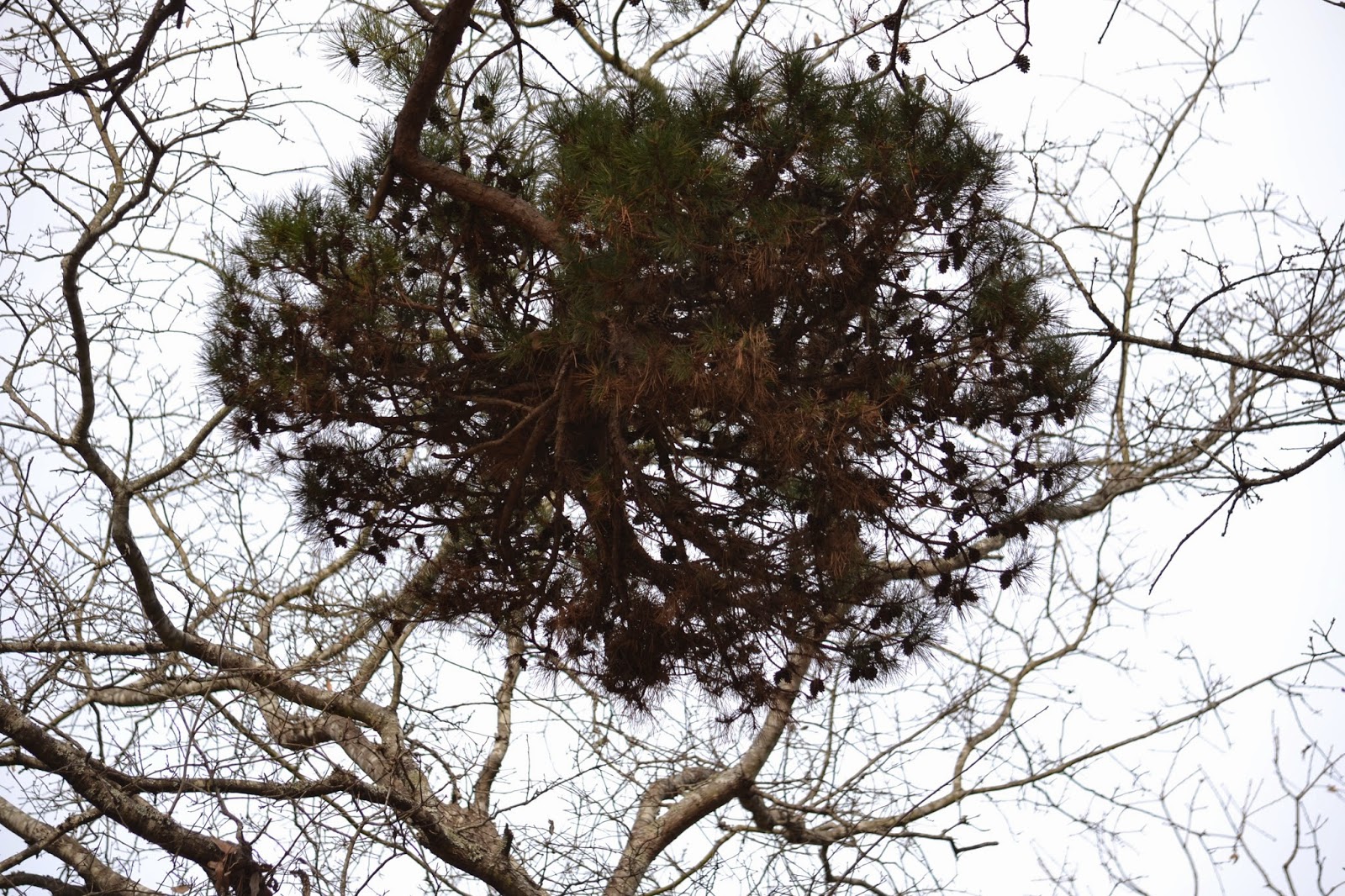
Ever see one of these?

On Timberidge Trail


This is a great example of a broom or witch’s broom. These are point mutations that cause the formation of dense, dwarf growth and abnormal tree branching in an otherwise normal tree or shrub. I have seen them here on our pine trees. Brooms can be caused be a variety of factors including diseases, aphids, environmental stress and random mutations. 

Horticulturists and plant collectors utilize these mutations to create cultivars such as dwarf conifers and weeping trees. The Japanese cultivate miniature Bonsai trees from these mutations. Because of this, brooms are often a prized commodity and ‘brooming' or 'broom hunting’ is an active past-time for some people. Folks that find their first brooms are sometimes called ‘Baby broomers.’ Broom hunters are a focused lot and have been known to screech to a halt on a major interstate in their relentless pursuit of conifer conversation pieces.  So keep an eye out for brooms – and broom hunters!


But more importantly, I think brooming teaches us to really look at nature. Sometimes we miss a lot. Looking down we miss what is up in the trees. Looking far away we miss what is right under foot. Sometimes we are so rushed we miss the sweet smell of a flower, a colorful bird, the community of plants, the diversity of seeds and seedlings. But with a little practice, we can learn to notice. And we just might discover a new plant right under our nose, (and a lot of other wonderful things as well).


Wednesday, August 6, 2014

WORMS, BAIT AND POOP

So, I like Catalpa trees. . .probably the only person that does. When we were kids, we used the pods for sword fights; as an adult I love the orchid-like flower.


I walk under a big Catalpa every morning on my way to the garden or compost pile. Coming in to the house one morning last week, I felt something on my back and after dancing around for 5 minutes discovered about 20 caterpillars on my back and in my hair. Yipes! I've got worms - Catalpa worms!


The Catalpa caterpillar is the larva form of the Hawk or Catalpa Sphinx moth (Ceratomia catalpa), a gray nondescript moth.


What interests me is that the moth and the tree have coexisted for thousands of years and depend on each other. The tree is the only tree that the caterpillar eats. In fact the caterpillars can completely defoliate a tree 3-4 times during a summer yet the tree survives and most always come back looking healthy. No other tree can withstand this devastation.


The catalpa sphinx overwinters as a pupa in the soil under the tree on which it has eaten. In spring, pupae work their way to the surface of the soil and moths begin to emerge shortly after the Catalpa tree has leafed out.

And, like anything else, someone has found a way to make a buck selling the caterpillars. Fisherpersons (is that a word?) sometimes propagate the trees just to harvest the caterpillars. They are considered excellent catfish bait – the caterpillars not the fisherpersons. A caterpillar can be divided into 3-4 pieces of bait and because of the caterpillar’s skin is tough it isn't easily taken off the hook by the fish. The caterpillars can even be frozen and thawed and used. . the catfish are none the wiser. Or, the caterpillar can be “pickled” with corn syrup and stored in a jar in the refrigerator to be used as bait. I even found a guy selling a special container in which to freeze your caterpillars.


Another positive is that the frass (poop) fertilizes the tree and anything else under the tree. . .Yipes! I probably had caterpillar poop in my hair.


Saturday, January 4, 2014

NEW YEAR'S RESOLUTIONS


In 2012, Time magazine listed the top 10 New Year’s resolutions that were most often broken as:

1.  Lose weight and get fit
2.  Quit smoking
3.  Learn something new
4.  Eat healthier and diet
5.  Get out of debt/save money
6.  Spend more time with family
7.  Travel to new places
8.  Be less stressed
9.  Volunteer
10  Drink less

After reviewing this list (and being guilty of breaking one or two in the past), I decided not to set myself up for failure. Putting my thinking cap on, I have come up with my 10 New Year’s resolutions that if I follow to a ‘T’ I will have success. Plus my garden, the birds and other creatures living there will benefit.

  1. I will not plant vegetables or fruit-producing plants in the shade. Just seeing the sun from the area where the plant will go does not mean ‘sun.’ Most plants need at least 6 hours of FULL sun with vegetables needing 8-10.
  2. I will invest in good gardening tools and equipment. Selecting, investing in, and maintaining tools that are dependable can save much time, money, energy and frustration.
  3. I will not be deceived by weekend specials at the big box stores. Most of these ‘deals’ offer plants that bloom in the dark, grow 40’ in one year and eliminate household odors. They include grass that never needs mowing and plants that never need watering. Be wary fellow gardener!
  4. I will never plant more of ‘anything’ that I cannot maintain. Recognize your limitations (physical, mental, financial and time). Choose easy-to-care for plants that are tried and true performers in East Texas climate and soils.
  5. I will not believe in miracles. Miracles are too precious to be sold in little plastic bottles. Products with secret ingredients that ‘cannot’ be listed on the label are suspect. Keep plants healthy with periodic applications of the appropriate fertilizer. Healthy plants are less susceptible to disease and insects.
  6. I will be wary of sales. A dead plant is not a good deal. Sales are generally for dying plants, excess supplies of non-adapted plants or poor-quality plants.
  7. I will consider sources of information carefully. I will seek out sound gardening advice from authorities (local garden experts, extension agents and Cecil).
  8. I will not over-indulge my plants. Plants will not grow faster or bigger with kindness! Do not put twice the amount of fertilizer recommended,  water too often or spray with pesticides made double strength. Avoid the “if a little does some good, a lot will be better” philosophy.
  9. I will plant the right plant at the right time in the right spot. Don’t try to cheat by planting too soon. Trying to have the first tomatoes of the season among your friends will only damage your plants and reputation. Learn the requirement of each plant for your landscape (light, water, soil, extra care or protection, pruning, etc.).
  10. I will recognize my mistake(s) and take action. Make the right decision first to avoid suffering consequences for years. Don’t think you can take a regular crape myrtle and prune it to dwarf size because it blocks your window. Constantly pruning shrubs to fit a location can easily be remedied by replacing with appropriate sized varieties.


Now, see these resolutions will be easy to keep. And, most of these resolutions include the Time top 10 in some fashion as well. Except for the drinking - you must have a glass of wine in the garden now and then.
Garden on!


Sunday, October 20, 2013

Autumn Stroll Around the Ranch


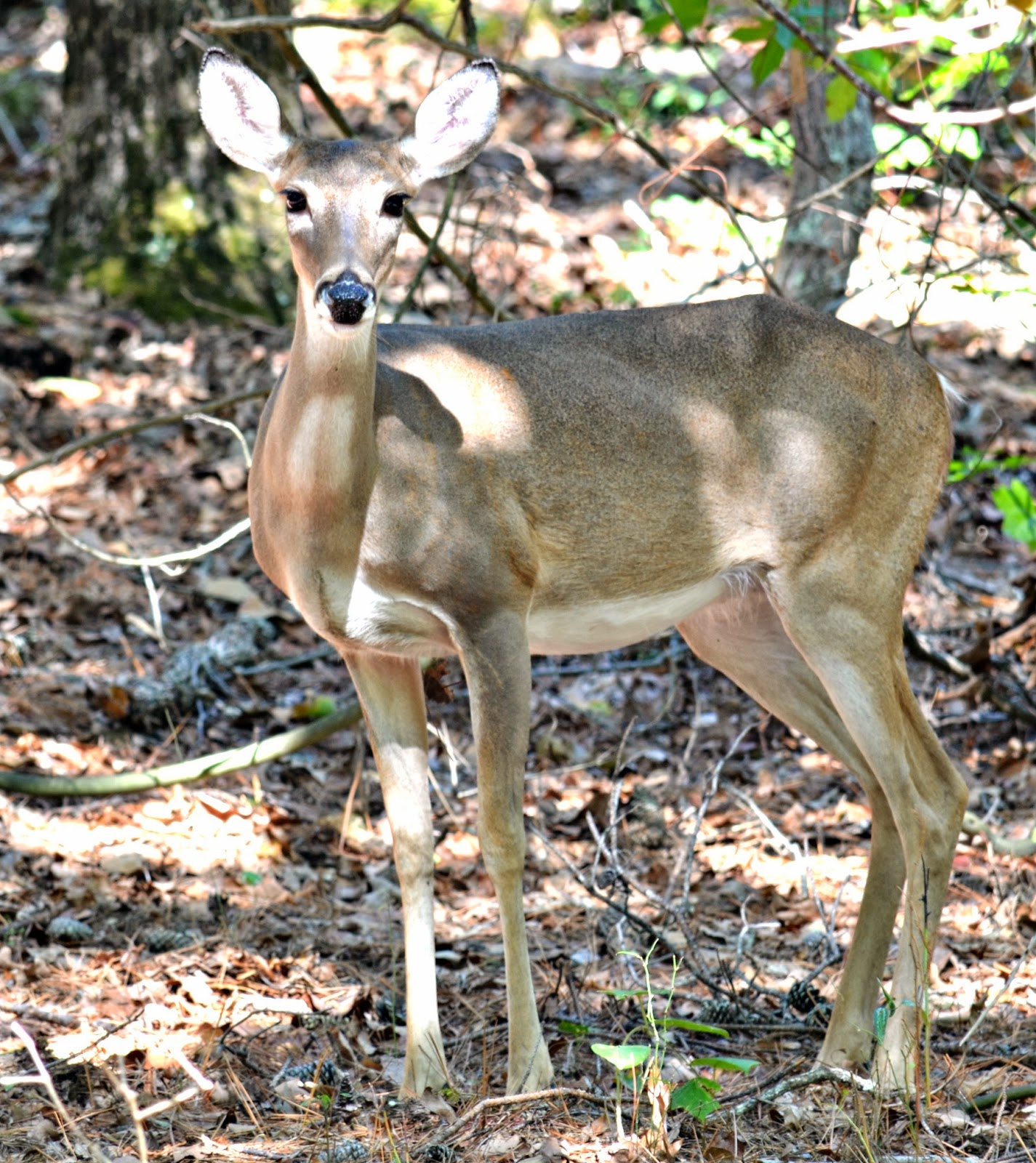
A little solitary time for this doe

Homeowners have begun decorating for the upcoming season


Last of the Poke berries

Even though scorched, this Sweetgum is showing its fall colors
The Sweetgums are one of the first trees to change colors here

A lush carpet of moss

Some creature's hidey hole

This dogwood has no leaves but is full of fruit


Art in nature


Even a log pile can be art

White Gayfeather (Liatris)

The oak leaves are beginning to change

Jack-o-lantern mushroom (Omphalotus olearius) - I think


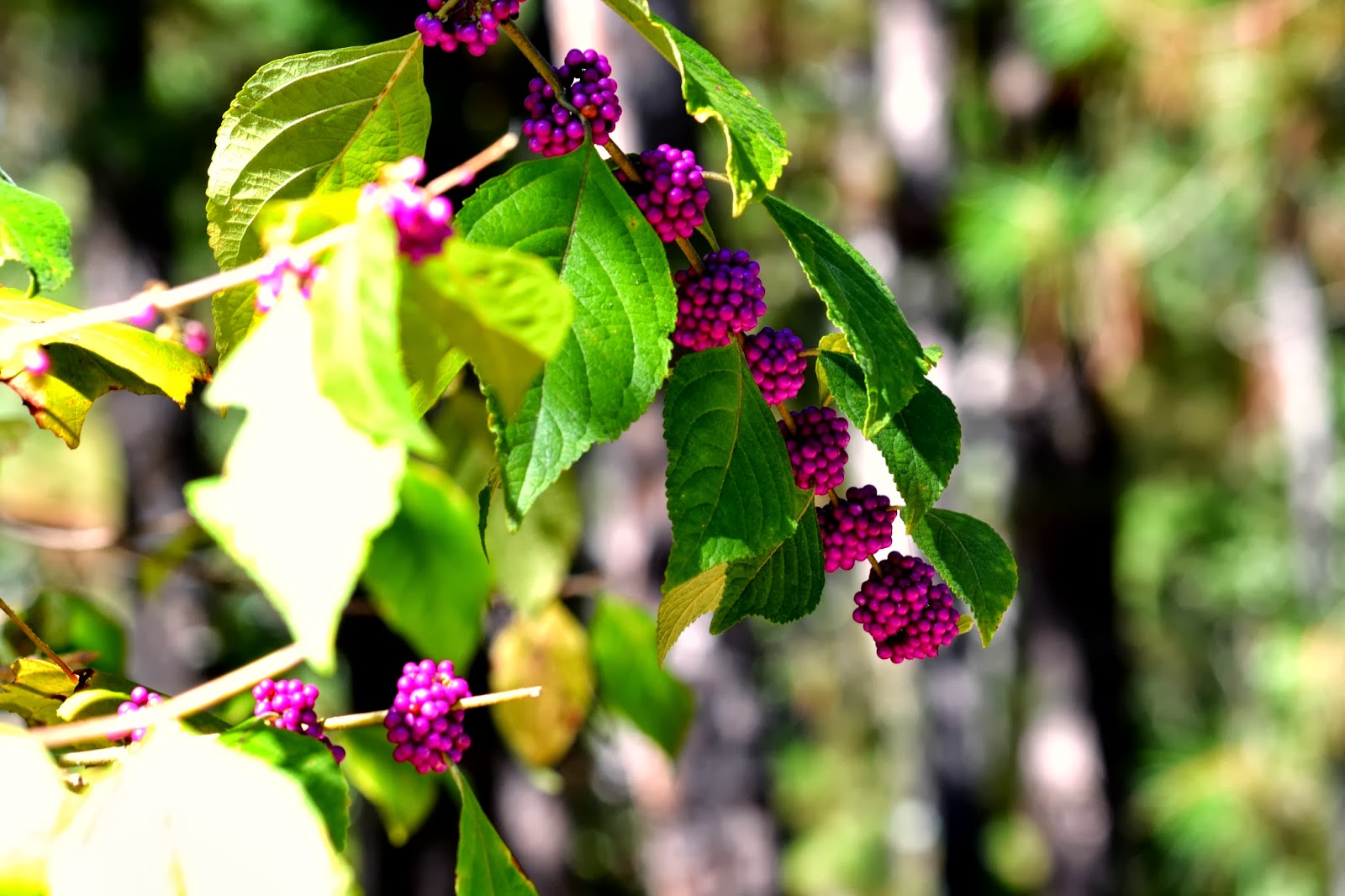
American Beautyberry (Calicarpis americana)

The Yaupons have fruited

Resurrection Fern


Sassafras trees are unusual because they have three distinct 
leaf patterns on the same plant, unlobed oval, bilobed (mitten-shaped), and trilobed (three-pronged)
Colorful trilobed Sassafras leaves


Wednesday, March 6, 2013

Suddenly Spring!


Fifteen days until spring! Hurry, please hurry! The Farmers’ Almanac states that on March 20th, the vernal equinox is at 8:02 a.m. (CDT). But, I don’t think I will sit and watch to see if spring will begin precisely at that time. I can smell it, hear it and see it. And, yes, it is 32 degrees at night.

All winter I have been looking at the bleak landscape trying to perceive it full of bounty and color. I have been rethinking the plants, moving the plants, and reading gardening catalogs. So it is pure joy to see, hear and smell the first signs of upcoming spring.

Red maple
Have you seen them? Most people are looking on the ground for the signs of spring. Look up!! See that little bit of scarlet red on the limbs of those trees along the side of the road. Those are the red maples that are budding out. Not only does the Red Maple (Acer rubrum) give us a wonderful show in the fall but it is one of the first trees to flower in the spring.


And then there is the flowering Quince (Chaenomeles speciosa), which brings back memories of my Mother’s gardens. It is one of our earliest flowering shrubs and is in the rose family. Seasoned gardeners may also know this plant simply as japonica. It is long-lived plant; you can still see it flowering on properties where old homesteads were. It is especially lovely blooming among the Wild Plum (Prunus Americana). And then there are the Snowflakes, Little Sweeties and Redbuds. Sigh!

Flowering Quince and Wild Plum
Little Sweeties
Snowflake

Edmond, Oklahoma redbuds


The birds are singing again -a sure sign of spring. There is a big difference between a bird's song and its call. Singing usually is a more melodious sound, while calling often is sharper and more direct and usually a sign of alarm. Spring is the time when most birds are busy mating and building nests. As female songbirds arrive to nesting grounds, they hear the males singing. If a song attracts them, a female will stop to look over the male, check his plumage to determine if he has desirable genes, and then explore his territory. It is the female that selects a mate. Wonder if we women should have our future partners sing?

What is the smell of spring like? It is earthy and composty. Sorry that is the only way I can describe it. You know it is one of those smells you can only describe but not name. It is kinda like the rain on the hot pavement smell. But the smell of spring has a name! Scientists call the chemical that makes dirt smell fresh geosmin.  It is caused by plant munching bacteria that live in the soil. Not very romantic.

Ah, spring - new life, little buds, increasing daylight, and warming temperatures. So stop for a moment, look up, take a deep breath and listen closely. Spring!

Saturday, November 10, 2012

What the Heck is That? #2

It is a coolish fall day and the thought occurred to me that soon I will be wanting a fire in the old fireplace. And, to start a fire you need kindling. I don't have to go far to get what I need. I have an entire backyard of kindling.

My backyard

Now to get someone to pick it up for me. And, . . . .that someone would be me.

I started picking up all of these nice pencil-sized shellbark hickory limbs thinking they would make good fire starter. 

Shellbark hickory limbs

I began to notice something strange. The ends of the limbs were perfect cuts. Almost like a miniature beaver had its way with them.


My good friend, Cecil (yes, someday I will write about him but I can't do him justice in my blog. . he is a one-of-a-kind) informed me that it was the Twig Girdler beetle. Ack!

The Twig Girdler is simply trying to complete its life cycle in my trees. The adult beetle emerges in late August-October to feed on the bark near the ends of the branches. The adult lays its eggs during the cutting process and the twigs are girdled because the larvae are unable to survive in living twigs.

The small larvae hatch and overwinter in the dead twig and when spring arrives, the larvae grow rapidly. They migrate to the end of the twig where they transform into a beetle in 14 days! This happens usually in August and thus there is only one generation a year. That is the good news.

The bad news is insect control is difficult since the larvae are protected in the twig. The best method of controlling these creepy crawlies is to accept the problem, rake up all terminal branches (remember there are some still hanging in the trees) and burn them. Ah, ha! A fire after all!


Monday, October 22, 2012

Fall Leaves Fall


Have you seen it? That little bit of scarlet in the trees along the side of the road. Me thinks fall is here because the red maples' leaves are, well, turning red.

We are blessed with the plentiful Red Maple (Acer rubrum) out here in the piney woods of east Texas. The tree can attain a height of 100 feet and a diameter of 3 feet. I love that each leaf is colored red, green and yellow.

Red Maple


Another colorful plant that gives tree bark a beautiful red necklace is Virginia Creeper (Parthenocissus quinquefolia). Folks often mistake this wonderful vine for poison ivy. Poison ivy has 3 leaves; Virginia Creeper 5. Remember "leaves of three, let it be; leaves of 5, let it thrive."

Virginia Creeper

And my favorite tree for fall color is the Sassafras (Sassafras albidum). This tree is unusual in that it has three distinct leaf patterns on the same plant, unlobed oval, bilobed (mitten-shaped), and trilobed (three-pronged).  The roots of this tree are used to brew a sweet spicy tea. The leaves are used in thickening soups. The orange wood has been used for cooperage, buckets, posts, and furniture and the oil is used to perfume some soaps. 

Sassafras

And then there is the FarkleberrySparkleberry and Huckleberry which is a shrub with three names.

 Farkleberry, Sparkleberry, Huckleberry
(Vaccinium arboreum)

There are many other trees out here that provide a riot of color during the fall. I can't leave out the Dogwood, Sweetgum, Slippery/Winged Elm, Hickory and Walnut.

But, whether it is our wonderful Red Maple, the Virginia Creeper or Sassafras, the fall colors of these are not to be missed. 

Fall, leaves, fall; die, flowers, away;
Lengthen night and shorten day;
Every leaf speaks bliss to me
Fluttering from the autumn tree.

I shall smile when wreaths of snow
Blossom where the rose should grow;
I shall sing when night's decay
Ushers in a drearier day.
Emily Jane Brontë

Tuesday, April 17, 2012

Redbud Tree

Recently, I had the opportunity to visit my family in the great state of Oklahoma. While there I not only experienced “cold core” tornadoes but also the beauty of the Oklahoma state tree, the Redbud.

After doing much research, I have come to the conclusion that there is the Eastern Redbud (Cercis canadensis) with the Texas variety being (Cercis canadensis var. texensis). The Texas redbud grows in thin, calcareous well-drained soils (now get this) west of the eastern redbud's native habitat. It is smaller and more drought tolerant than its eastern relative, with thick, leathery, much smaller leaves that have wavy margins. In early spring, before leaf-out, a profusion of small, sweet pea–shaped, lavender-pink to rosy purple flowers appears on twigs, branches, and even the main trunk. It is most commonly multi-trunked. Many trees are sterile and produce no fruit. Here in the piney woods, the redbud is a frequent native understory tree and when blooming makes a colorful statement with our pine trees as a backdrop.
Redbuds in Edmond, OK

Photo courtesy of Butterflies of Massachusetts
Here are a couple of interesting facts about the redbud. The Cercis siliquastrum, or Judas tree, lives in Mediterranean and Asia minor countries. This tree is the one most associated as "Judea's tree" and is supposedly the tree Judas Iscariot hanged himself after betraying Christ. In some parts of southern Appalachia, green twigs from the Eastern redbud are used as seasoning for wild game such as venison and opossum (probably needs lots of seasoning). Because of this, in these mountain areas the Eastern redbud is sometimes known as the spicewood tree. Also the redbud found in the Appalachians is the larval host for the Henry's Elfin butterfly.

My favorite redbud cultivar is the Forest Pansy Redbud. It blooms as pretty as the Texas redbud but the difference is its purple leaves. The heart-shaped leaves open bright reddish-purple and gradually mature to a more muted purple (or purplish green) in our hot summer climate. 

For a beautiful view of Oklahoma redbuds, visit my friend's (Linda) blog, The Potager, at:

Although short blooming, the redbud is a sure sign of spring and one of our most charming native trees. So leafing you on a high note - sing along with one of two state songs that everyone knows by clicking below.