Wednesday, June 27, 2012

June Wildflower Wednesday

For the second day in a row, I have been up before sunrise or as I like to say "Cecil time" (inside joke). So what to do this early in the morning? I should be watching Wimbledon but my blogger buddies reminded me that it is Wildflower Wednesday so I grabbed my hat, mosquito repellant, and camera to see what might pique your interest in my garden. There is this fine line of time when I want the dawn just bright enough to see a copperhead before I step on it but still dim enough that all the other creatures are just waking.

Broad Band Copperhead

Southern Copperhead

Immature Copperhead - notice the triangular shaped head characteristic of a venomous snake  

One of my favorite native flowers that came with my property is the Hairy Sunflower (Helianthus hirsutus). It can be found in dry open woods, savannas, prairies, and along roadsides. The ray flowers are 1 inch long and yellow. Disk flowers are brownish to yellow.
Hairy Sunflower


My Hairy Sunflowers grow in a colony in mostly shade at the back of the garden. They provide a brilliant yellow backdrop to the Purple Coneflower (Echinacea purpurea), don't you think?


So next time you go to make a plant shopping (is there any other kind), think about purchasing natives that are uniquely suited to your area. Why?

1. They take less work and resources. Since native plants have spent centuries adapting to your garden’s growing conditions they aren’t going to need much in the way of supplemental fertilizer, watering, spraying and winter mulching.
2. Local wildlife, birds, bugs, bees and butterflies have a relationship with your native plants. They rely on them for food, shelter and nesting.
3. Native plants tend to be well behaved in the garden. Plant natives are rarely invasive. Having evolved within the community, they have natural predators that help to keep them in check.
4. They are beautiful.
And finally,
5. As Lady Bird Johnson said, native plants "give us a sense of where we are in this great land of ours."


Tuesday, June 12, 2012

What's with the Drought?


I don’t know if you have noticed it in your gardens, but my plants and wildlife appear hardier and more abundant this year. Did the drought do that?
 
This year I have been blessed with a multitude of wildlife - common in most gardens - but are new to my gardens. Did the drought do that?
Eastern Box Turtle - female


This year I have witnessed the evolution of the Gulf Fritillary. 

Egg of Gulf Fritillary
Larvae of Gulf Fritillary       

Even though the larvae is still consuming my passion vine (Passiflora incarnata), I let them be knowing I will be blessed with a garden with wings in the future.

Emerging from chrysallis

Adult Gulf Fritillary 

 I smile when I see the butterflies happily sipping the nectar on the bee balm. Did the drought do that?


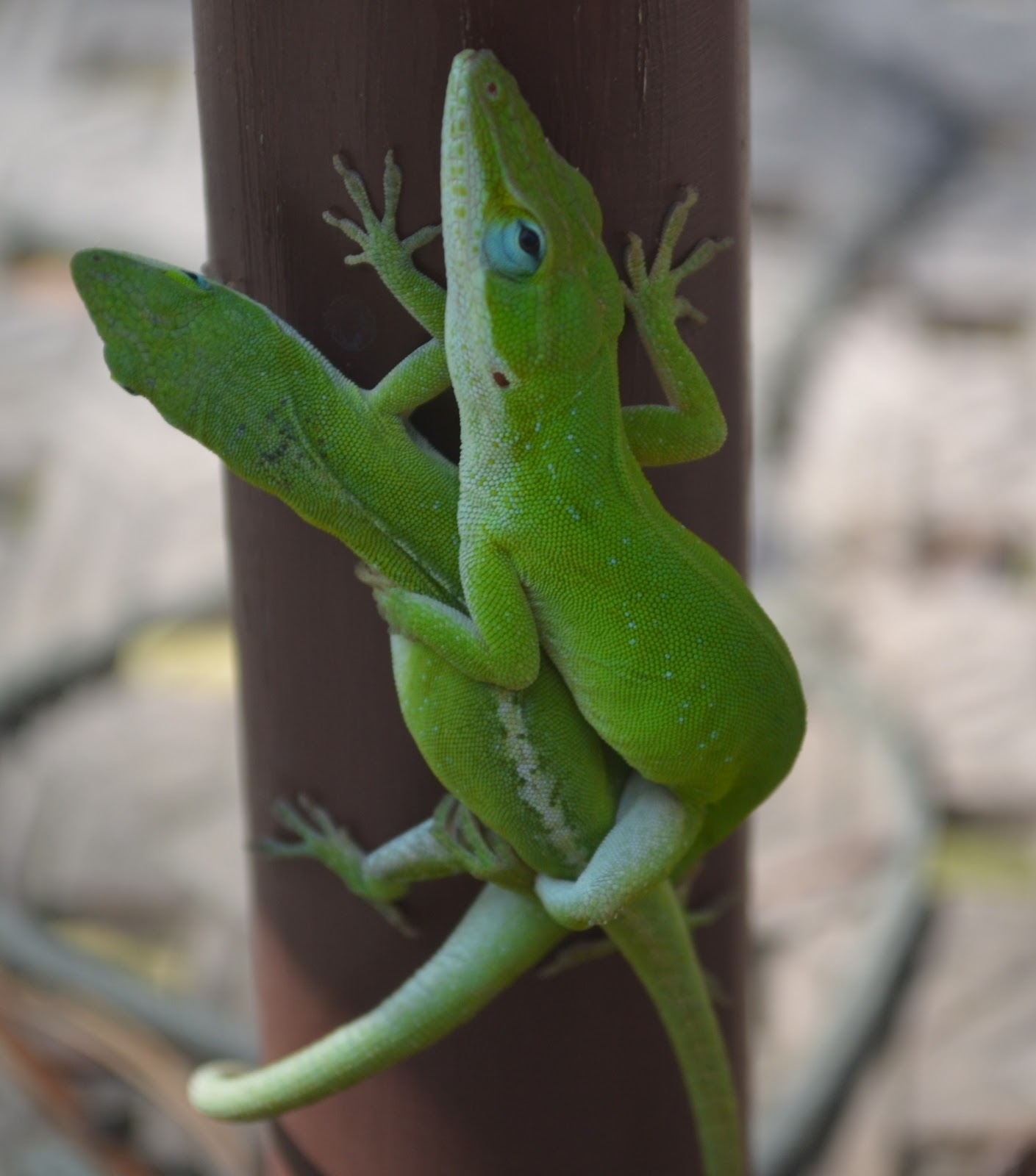
Then there is the frolicking and fornicating. Did the drought do that?

Green Anoles

Green Tree Frogs 


I became concerned when this guy followed me in the garden.

During a drought, plant roots will grow deeper looking for nourishment and this makes the plants stronger (if they survive the drought). The next year, these hardy plants proliferate and provide abundant food sources for all types of creatures. So, yes, the drought did that!

Are you experiencing a better garden this year? Please leave a comment and let me know.

Monday, June 4, 2012

The Turks are Here!


One of my favorite plants is Turk’s cap and it is one that you should check out. The botanical name is Malvaviscus arboreus var. drummondii but most know it by the beautiful red “Turk’s cap” bloom. This perennial flowering shrub will reach 2-4 feet by the end of the summer, taller in areas where it receives some sun, shorter when it is in full shade. Yep, it can be grown in full shade.

Red Turk's Cap
Pink Turk's Cap
This plant begins to bloom in late spring and continues until fall, producing unique bright red blooms (there are white and pink flower forms) that never unfurl. The name “Turks Cap” comes from the flowers that resemble a Turkish fez. The pistils protrude beyond the petals in the center of the flowers. 

Blooms are followed by marble sized red fruit. The flowers attract hummingbirds and butterflies (Gulf Fritillary, Black Swallowtail and Painted Lady) and the seeds are eaten by a variety of birds.

The plant can be propagated from seed, soft wood cuttings, dug and divided and by layering. Turk’s Cap likes well-drained soil and soil that has been amended with compost or organic matter. After planting, water well and mulch, then after the plant is established supplemental watering is only needed during a prolonged drought. This plant has no pests but might get mildew if planted in full sun. If the plant gets leggy it can be sheared back a little in the early summer to encourage more branching and to form a more dense form. The plant will spread slowly – but is not a problematically invasive plant. 

Turk’s Cap is a native of Texas and Mexico and even though the fruit is prized by birds and other wildlife, this plant is somewhat deer resistant! That is good news for us Holly Lake denizens.


Friday, May 11, 2012

What Will They Think of Next?

What do you get when you cross a zebra with a horse? You get a zorse, of course, of course. My kingdom for a zorse. . .oh, Shakespeare my bad. I digress.

Zorse
Hebra
A Zorse is a result of a zebra stallion mating with a horse mare. But, crossing a horse stallion with a zebra mare results in a Hebra. Zorses are more common than Hebras. Zorses inherit the color from their horse parent and stripes from the zebra parent. 


Zebroid

Zedonk
The Zorse and Hebra should not be confused with the zebroid (zedonk, zebra mule or zebrule) which are the offspring of any cross between a zebra and mule or donkey. Offspring of a donkey sire and zebra dam, called a zebra hinney or donkra.

The Zorse was originally created in Africa at the turn of the 20th century. These animals are considered hardier than horses and are still used today in the mountains. But because they are half zebra (i.e. wild animal) they are different from the domesticated (tame) horse. They are quicker to react to danger, more cautious and will defend themselves when they feel trapped.

None of these hybrids should be confused with the centaur which is half ass and half horse.
Centaur

Saturday, May 5, 2012

The shame of it. . . and in front of women and children!


                                      Birds do it, bees do it
                                    Even educated fleas do it
                                   Let's do it, let's fall in love.


Wednesday, April 25, 2012

Wildflower Wednesday

Many of the gardening blogs, that I follow, are calling the 4th Wednesday of the month as Wildflower Wednesday. My friends at Clay and LimestoneRed Dirt Ramblings, and May Dreams Gardens  are celebrating wildflowers from all over the US of A. So, I thought I would join the party and feature some of the wildflowers in my gardens. Enjoy!
Coral Bean (Erythrina herbacea)

Wine-cup (Callirhoe involucrata)
Dakota Vervain (Verbena bipinnatifida)
Milkvine (Matelea cynanchoides)
Prairie Spiderwort (Tradescantia occidentalis)

Queen Anne's Lace (Daucus carota)

Blue Larkspur (Delphinium carolinianum)

Brown-Eyed Susan (Rudbeckia)

Showy Primrose (Oenothera speciosa)

Indian Blanket (Gaillardia pulchella)

So, gentle reader, what do you think? Can the ordinary urban flower bed feature wildflowers? Send me your thoughts!

Tuesday, April 17, 2012

Redbud Tree

Recently, I had the opportunity to visit my family in the great state of Oklahoma. While there I not only experienced “cold core” tornadoes but also the beauty of the Oklahoma state tree, the Redbud.

After doing much research, I have come to the conclusion that there is the Eastern Redbud (Cercis canadensis) with the Texas variety being (Cercis canadensis var. texensis). The Texas redbud grows in thin, calcareous well-drained soils (now get this) west of the eastern redbud's native habitat. It is smaller and more drought tolerant than its eastern relative, with thick, leathery, much smaller leaves that have wavy margins. In early spring, before leaf-out, a profusion of small, sweet pea–shaped, lavender-pink to rosy purple flowers appears on twigs, branches, and even the main trunk. It is most commonly multi-trunked. Many trees are sterile and produce no fruit. Here in the piney woods, the redbud is a frequent native understory tree and when blooming makes a colorful statement with our pine trees as a backdrop.
Redbuds in Edmond, OK

Photo courtesy of Butterflies of Massachusetts
Here are a couple of interesting facts about the redbud. The Cercis siliquastrum, or Judas tree, lives in Mediterranean and Asia minor countries. This tree is the one most associated as "Judea's tree" and is supposedly the tree Judas Iscariot hanged himself after betraying Christ. In some parts of southern Appalachia, green twigs from the Eastern redbud are used as seasoning for wild game such as venison and opossum (probably needs lots of seasoning). Because of this, in these mountain areas the Eastern redbud is sometimes known as the spicewood tree. Also the redbud found in the Appalachians is the larval host for the Henry's Elfin butterfly.

My favorite redbud cultivar is the Forest Pansy Redbud. It blooms as pretty as the Texas redbud but the difference is its purple leaves. The heart-shaped leaves open bright reddish-purple and gradually mature to a more muted purple (or purplish green) in our hot summer climate. 

For a beautiful view of Oklahoma redbuds, visit my friend's (Linda) blog, The Potager, at:

Although short blooming, the redbud is a sure sign of spring and one of our most charming native trees. So leafing you on a high note - sing along with one of two state songs that everyone knows by clicking below.