Thursday, November 14, 2013

Owl Eyes

Fellow blogger, Rebecca Deatsman, wrote a wonderful piece of her encounter with a Short-eared Owl at Grasslands National Park which is  a Canadian national park located in southern Saskatchewan.


Her essay is not so much a study of the Short-eared Owl but more about the way nature speaks to us. Click on the link below and enjoy!


Sunday, November 3, 2013

A Garden Give-away

Fellow Oklahoman and gardening blogger, Dee Nash, is having a fantastic give-away and I want you to check it out. Dee of Red Dirt Ramblings is giving away bulbs!! But don't just go to her blog for the freebies - check out all her gardens, her ideas, her suggestions, her resources. Much of what she has learned and applied to her gardens can be used down here in the piney woods of east Texas.

Here is the link. I know you will enjoy meeting Dee at Red Dirt Ramblings.

Wednesday, October 30, 2013

Mother Nature's Amethyst

Fall in the piney woods of east Texas, brings the colorful leaves of the Sweetgum and Sassafras trees
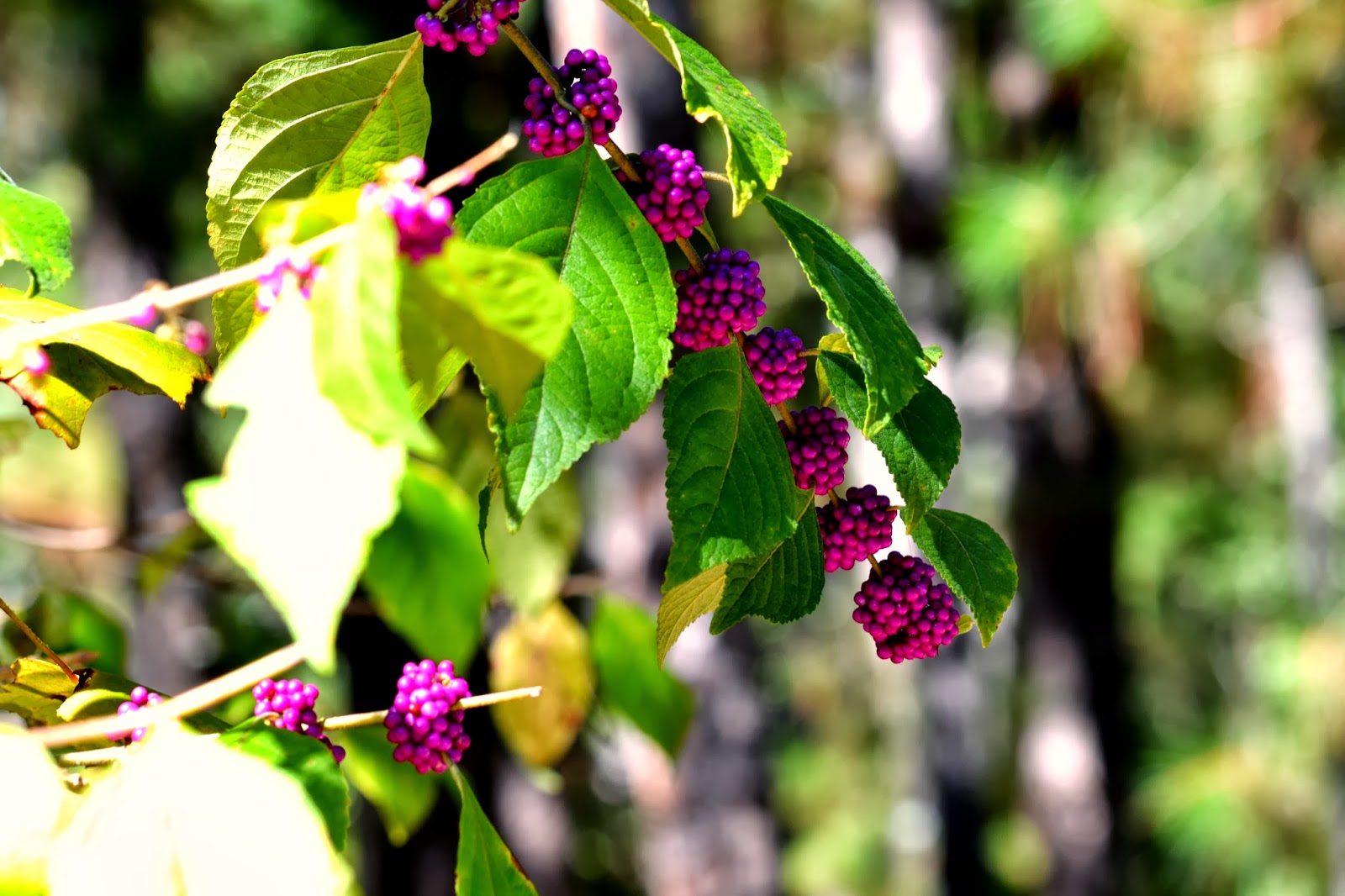
but nothing compares to the amethyst jewel-like berries of American Beautyberry (Callicarpa Americana). This plant also goes by the names French Mulberry, American Mulberry, Spanish Mulberry, Bermuda Mulberry, Sour-bush, Sow-berry.


East Texas, with its rich woods and thickets, provides the perfect growing conditions for this understory plant. It is best suited to semi-shade sites with moisture although it can tolerate full sun if given supplemental watering. And, as we have seen the last couple of years, it can tolerate some drought. It has long arching branches which can be pruned in half in the winter to create a more compact shrub. In summer, Beautyberry has small, greenish-white flowers but Mother Nature blesses this plant with clusters of deep purple berries in late summer and fall.  
Enjoy the berries. . .the seeds are favorites of our Robins and Cedar Waxwings – so much so that the berries will disappear in a matter of days. Birds do the propagating of this plant when they deposit the already ‘fertilized’ seeds. Other critters that enjoy the fruit are armadillos, raccoons, wood rats, foxes, opossums and deer.


American Beautyberry has long been used as a folk remedy to prevent mosquito bites. Old timers talk about crushing the leaves and putting them under the harnesses of their horses and mules to repel flies.
Native Americans used the Beautyberry as a diuretic, a cure for dropsy, dysentery and stomach aches, colic and for sweat baths for the treatment of malaria, rheumatism and fevers. The USDA Agriculture Research Service has patented the 4 chemicals in this plant as a mosquito repellent. However, the toxicity is still unknown. I have tried crushing the leaves and rubbing them on my legs to see if this works and it appears it does. One site I found recommended boiling the leaves, straining and combing the liquid with oil and rubbing it onto the skin. As always, do your own research before trying this.

American Beautyberry berries are edible when fully ripened but only in very small quantities. Again, do your research before sampling. Fully ripened, the berries will be dark purple or magenta but not wrinkled or dry. The berries are mealy and have a medicinal flavor so I don’t know why anyone would eat them. They can be made into a beautiful jelly and there are several recipes on the internet. The jelly tastes of rose petals and champagne. The berries can also be made into wine. Now we are talking!


If you have Beautyberry on your property, consider keeping this plant in your gardens not only for food for wildlife but for the fall eye-candy.

Garden on!

Sunday, October 20, 2013

Autumn Stroll Around the Ranch


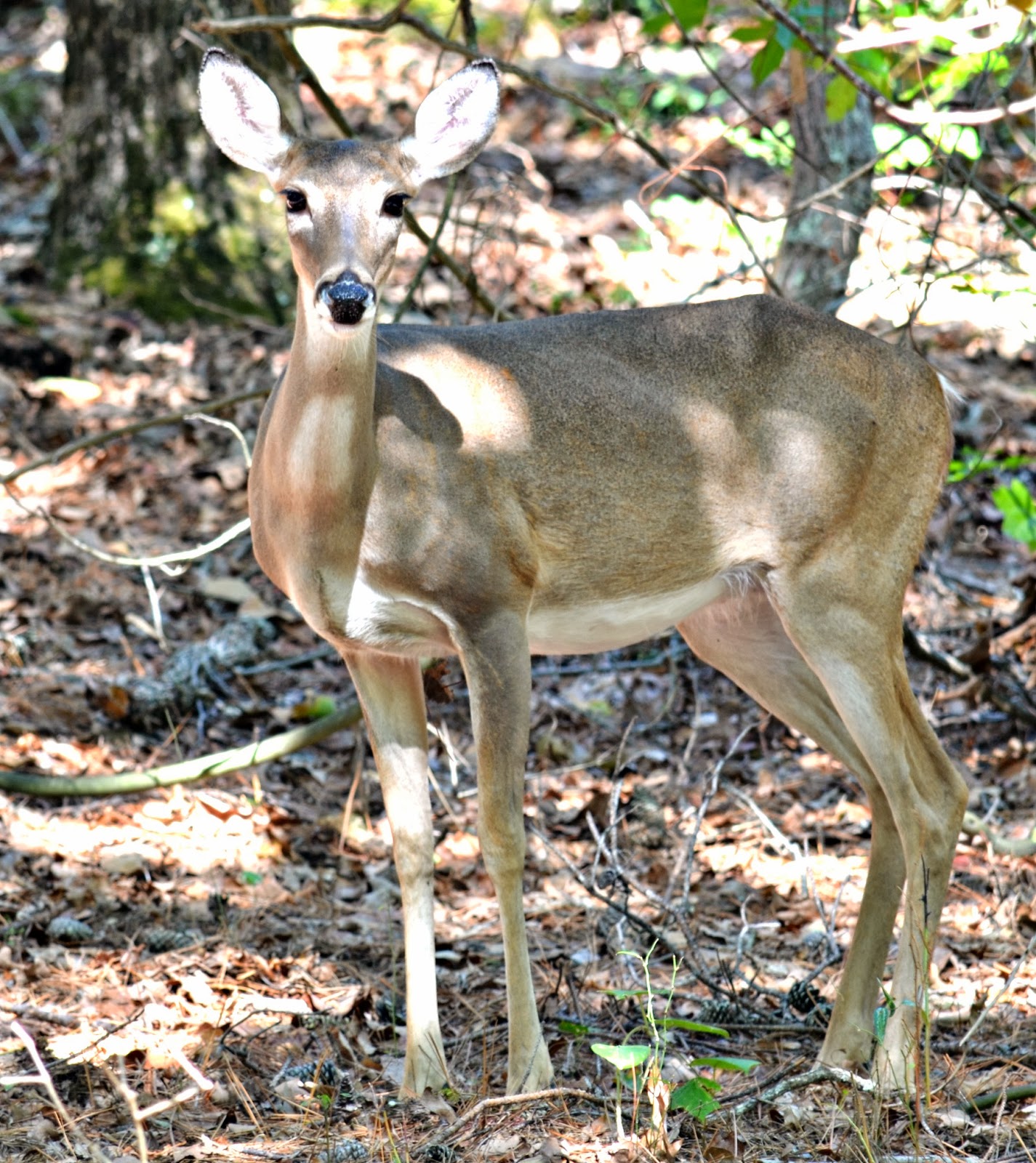
A little solitary time for this doe

Homeowners have begun decorating for the upcoming season


Last of the Poke berries

Even though scorched, this Sweetgum is showing its fall colors
The Sweetgums are one of the first trees to change colors here

A lush carpet of moss

Some creature's hidey hole

This dogwood has no leaves but is full of fruit


Art in nature


Even a log pile can be art

White Gayfeather (Liatris)

The oak leaves are beginning to change

Jack-o-lantern mushroom (Omphalotus olearius) - I think


American Beautyberry (Calicarpis americana)

The Yaupons have fruited

Resurrection Fern


Sassafras trees are unusual because they have three distinct 
leaf patterns on the same plant, unlobed oval, bilobed (mitten-shaped), and trilobed (three-pronged)
Colorful trilobed Sassafras leaves


Wednesday, September 11, 2013

Going Home. . . How I Will Miss You!

FALL IS HERE! I know, I know it is still 100º outside but now is the time to keep those hummingbird feeders up and full.


Autumn won’t arrive until September 22nd but despite the heat, the hummers have begun to migrate south. This hummingbird migration map is a great tool so be sure to bookmark this page not only to follow the fall migration but to prepare for the spring migration. Just click on this link: Migration Maps

Late summer into early fall is the peak of migration. About 75% of all the hummingbirds in the eastern half of the US migrate through Texas.  Out of 18 total species in the US, there are only two abundant species that nest in the east. They are the Ruby-throated (RT) and the black chinned, with the RT being the most abundant. 

Remember the hummers have made the spring migration to nest and raise their young so the number of birds migrating south may be twice that of the northward trip. The trip south includes all immature birds that hatched during the summer, as well as surviving adults. That is why you might be seeing so many at your feeders. It is important to leave the feeders up as long as possible.
Female RT


To make your own nectar, use 4 parts water to one part sugar (no red food coloring) and either boil or stir until the sugar is dissolved. Many of these birds fly non-stop, 500 miles across the Gulf of Mexico, an 18-22 hour trip.  They have to double their fat reserves to make this trip so they need all the help we can give them. Double fat reserve. . hummm, I must be a hummingbird!

A few fun facts about hummingbirds:

  • native only to the Americas
  • can hover in mid-air
  • flap their wings 15-80 times per second (depending on the species)
  • can fly backwards or vertically
  • their name comes from the characteristic humming sound of their wings.
  • has a extendable tongue that allows it to “lap” up nectar
Female using her tail to slow down for a landing
Wings beat so fast they are blurred


Here at Holly Lake we see the RT Hummingbird. The adult male, which is smaller than the female, has an emerald green back and an iridescent ruby red gorget (throat) that may appear black under some lighting conditions, gray flanks, and forked tail with no white. The adult female has an emerald green back, white breast and throat, and a rounded tail with white tips.

Male RT - Photo courtesy of Kathy Baker


By mid-November the fall migration is essentially complete but don’t be surprised if one should hang around into the winter months. And, since Ruby-throats live on average 3-5 years, it is not uncommon to have them return to the same feeder the next year.

Their brilliant colors, small size, fearless personalities and flying characteristics have won admiration from humans. These birds do not harm crops or livestock, make noise, foul cars or buildings with droppings, or bite when handled, making them the most benign of all birds. Enjoy these flying jewels in your gardens while they are here.

Sunday, August 18, 2013

Fashions for Gardening. . .Really?

I'll admit it. I get a lot of catalogs - the majority of which pertain to gardening, plants and seeds. Yesterday, I got a small periodical that had all sorts of women's clothing for gardening. Thinking that I needed special gardening clothes, I proceeded to look over the lavish styles made for hoeing weeds and planting seeds.


The summer section of the catalog featured a rather cute spaghetti tank-top shirt designed to suggest careless elegance and sexiness while gardening. This is a style my body type does not warrant. It would expose me to sun, mosquitoes - not to mention the neighbors.


The 'tops' section presented shirts that would make even your flowers swoon. Also described is a garden jacket with a paisley pattern on one side and quilting on the opposite. I am sure I will need a jacket here in Texas someday and after all paisley goes with flowers. 

In the fall section, I found sweaters, scarves and knitted hats all for added warmth. One matched them with form-fitting trousers  for a more casual appearance.


All of these fashions, that I must have just to make my garden grow, began to make my head spin and then I saw the cost of being stylish. This fancy schmansy style may look trendy but it could put me in serious debt.

Gardening in Texas is different. My own idea of garden fashion is jeans (shorts leave knees too exposed to cuts, bruises and bug bites). Mine are dirty, frayed at the bottom, shredded at the knees and comfortably baggy. 

T-shirts with gardening slogans like 'gardeners do it in the dirt,' or 'give a weed an inch and it will take a yard' are my favorites. Brownish gray socks are the best because you can't tell when they are dirty. To keep my pedi looking good, I wear red clogs bought at Canton First Monday Trades Days. I do have a pair of cutesy, wootsy, rubber Wellies which are great for those wintry, rainy days. 


Crocs that come in bright colors are definitely a no no in the garden. The holes in their tops lead to a whole host of wet and muddy problems. And, your feet will have a unique polka dot tan.

A hat is a must unless you want skin like a crocodile. Mine is a lovely pink wide-brimmed straw version which the hummingbirds just love. Sunglasses are also a must. I buy them at the dollar store because I either: 1) misplace them, 2) sit on them, or 3) lose them while bending over the pond to feed the fish.

A garden fashionista must accessorize, right? My accessories include a bandanna to wrap around my forehead or to wipe my brow when I sweat. I never glow. . .I sweat. For gloves, I swear by Atlas Nitril Touch (they come in 6 colors) and I get them at Lost Creek Gallery in Mineola.

Some gardeners wear a smart looking apron with pockets in which to carry their tools. I tried one but my loppers kept piercing my stomach and the belt tied around my waist just made me sweat more. I prefer to carry my tools in a slop bucket that I brought home from my family’s farm. You do remember what a slop bucket is, don’t you? I have never carried an English trug (a small wooden basket that looks fashionable but holds nothing) because, after all, THIS IS TEXAS.

Thank goodness the garden fashionista police can’t see me when I garden because I look a little more like this. And, chances are if you visit my garden
 

you are dressed very much like me.


You know, it could be worse. . . .


Garden on!


Thursday, August 1, 2013

Hornet? Wasp? What is It?

Have you been seeing these large wasps or hornets lately. I have had several on my back porch lately.


Well, our friend, Chris Wiesinger (aka the Bulb Hunter) of the Southern Bulb Company has found out what this thing is. 

Check out his post here: Cicada Killer


How dangerous are cicada-killer wasps? Cicada-killers are actually quite harmless.  Usually the cicada-killers you see zooming around are the males, which cannot sting.  A male stinger is a modified ovipositor; no male ants, bees, or wasps can sting.  To be stung by a female cicada-killer you need to either step barefoot on her or grab her with bare hands. 

This species nests in loose sandy soil where the female, after mating, will dig a burrow. She digs the soil with her jaws and moves it out of the burrow with her hind legs as she backs out. Chambers are located at the end of the borrow and each are large enough for a few cicadas. The female will paralyze a cicada, which are captured in flight, hold it upside down and fly to the burrow. You can imagine how difficult it must be flying all the while carrying something twice your weight! Women get all the difficult jobs, don't they, Ginger Rogers?

After depositing the "live" paralyzed cicada in the burrow, the female deposits an egg on the cicada and closes the round cell. Male eggs are laid on a single egg; female eggs are given two or sometimes more cicadas (this is because the female wasp is twice as large as the male and need more food). Eggs hatch in 1-2 days and the larvae eat the cicadas. Larvae grow for about 2 weeks and then spin a cocoon of silk and soil which remains in the burrow over the winter. Pupation happens in the nest in spring and the males appear first (around June or July) and mating takes place when the females emerge from the soil. The wasps die off in September or October. There is only one generation per year.


Predators of the cicada wasp include the velvet ant and humans.